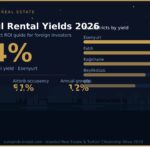
Istanbul Rental Yields 2026: Which Districts Deliver the Best ROI for Foreign Investors?
May 12, 2026
The Complete Guide to Off-Plan Property Investment in Istanbul 2026
May 18, 2026

If you are considering investing in Turkish real estate, understanding the VAT exemption property Turkey offers to foreign buyers could save you tens of thousands of dollars. Since 2017, the Turkish government has offered a significant tax incentive that allows eligible non-residents to purchase property completely free of Value Added Tax (KDV in Turkish) — a saving of up to 20% on the purchase price. In 2026, this exemption remains one of the most compelling reasons for international investors to choose Turkey over other Mediterranean markets.
What Is the VAT Exemption on Property in Turkey?
Turkey applies Value Added Tax (KDV — Katma Değer Vergisi) to real estate transactions at rates of either 1%, 10%, or 20%, depending on the property’s net usable area and classification. For foreign buyers who meet the eligibility criteria, this tax is fully waived, making Turkey one of very few countries in the world to offer such a generous fiscal benefit to non-resident property purchasers.
The exemption is governed by Article 13/i of Turkey’s VAT Law and was introduced as part of the government’s strategy to attract foreign direct investment in real estate. According to Turkey’s Investment Office, real estate is consistently one of the top sectors drawing foreign capital into the country.
Who Qualifies for VAT Exemption Property Turkey?
Not every foreign buyer automatically qualifies. The VAT exemption property Turkey offers is specifically available to: foreign nationals who do not reside in Turkey (i.e., those without Turkish residency permits); Turkish citizens living abroad with documented foreign residency; and foreign companies without a registered place of business, headquarters, or legal representative in Turkey.
The key requirement is that the purchase price must be brought into Turkey from abroad in foreign currency. Buyers must wire the funds from an overseas bank account in USD, EUR, GBP, or another approved foreign currency. This foreign currency transfer is documented and forms the basis of the exemption claim.
It is also important to note that the property must be kept for at least one year after purchase. If you sell within 12 months of buying, the Turkish tax authorities will require you to pay back the VAT that was exempted. This rule is monitored by the Turkish Land Registry, known as the TKGM (Tapu ve Kadastro Genel Müdürlüğü).
How to Apply for the VAT Exemption: Step-by-Step Process
The application process for the VAT exemption property Turkey provides is straightforward when you work with an experienced real estate agent. Here is a summary of the required steps:
- Agree on the property and price — negotiate with the developer or seller and confirm the VAT-inclusive price in writing.
- Open a Turkish bank account — you will need a Turkish bank account to receive your foreign wire transfer and make the payment.
- Transfer funds from abroad — send the full purchase amount from your overseas account to your Turkish bank account in foreign currency.
- Obtain foreign currency purchase certificate — your Turkish bank will issue a “döviz alım belgesi” confirming the funds came from abroad.
- Apply to the developer or notary — present your passport, tax number, and the bank document.
- Sign the sales contract without VAT — the final contract and title deed (TAPU) are issued with zero VAT charged.
This process is typically handled alongside the standard property purchase procedure. The team at Sun & Sands guides clients through every document and deadline to ensure a seamless transaction.
How Much Can You Save with VAT Exemption Property Turkey?
The financial impact of this exemption is substantial. Suppose you purchase a 120 m² apartment in a new development for $300,000. If the standard VAT rate of 20% applies (common for larger or higher-end units), the VAT would amount to $60,000. With the VAT exemption property Turkey offers, that entire $60,000 stays in your pocket.
For properties subject to the 10% rate, on the same $300,000 purchase price, you would save $30,000. This makes the VAT exemption one of the highest-value benefits available to foreign real estate investors anywhere in Europe or the Middle East. According to data from TÜİK (Turkish Statistical Institute), foreign buyers purchased over 35,000 properties in Turkey in 2024 alone.
Other Tax Advantages Worth Knowing
The VAT exemption is just the beginning of Turkey’s investor-friendly tax regime. Buyers should also be aware of: a flat 4% title deed fee (TAPU Harcı); progressive rental income tax rates starting from 15% with significant deductions; full capital gains tax exemption for properties held more than 5 years; and relatively low inheritance and gift tax rates compared to EU standards. Knowing how to leverage the VAT exemption property Turkey provides is one of the smartest first steps any foreign investor can take.
For investors exploring the Sun & Sands property portfolio, our team provides a full tax breakdown specific to each listing so you know exactly what you will pay before signing anything.
Common Mistakes to Avoid
Many foreign buyers miss out on the VAT exemption property Turkey provides simply because they do not structure their purchase correctly from the start. The most common errors: sending funds in Turkish Lira (the exemption only applies to foreign currency wired from abroad); not keeping the property for 12 months (early resale triggers VAT repayment); working without a professional agent (missing bank documentation can invalidate the claim); and confusing KDV (VAT) with other purchase fees — the exemption applies to VAT only, not the title deed fee or notary costs.
A few further compliance details worth knowing: cash payments are not accepted under any circumstances and will disqualify the application entirely — every payment must be traceable via bank transfer, and currency conversion must go through a licensed Turkish bank, since transfers via fintech or online-only banking apps do not generate a valid FX certificate. If VAT is repaid because the property is sold within 12 months, Turkish tax authorities also add accrued interest from the original purchase date, not just the VAT amount itself. And a reminder on scope: the exemption never covers the title deed transfer fee, which runs to approximately 4% of the declared property value, or notary and agency costs — budget for these separately.
Start Your Tax-Exempt Investment Journey Today
Frequently Asked Questions: VAT Exemption Property Turkey
Does the VAT exemption apply to all types of property in Turkey?
The VAT exemption property Turkey offers applies primarily to new-build residential and commercial properties purchased directly from a developer or construction company. Resale properties (second-hand) from private sellers are generally not subject to VAT, so the exemption is most impactful for off-plan and new construction purchases. Some commercial property types may also qualify — your agent can confirm eligibility for each specific listing.
Can I rent out the property during the one-year holding period?
Yes. The one-year restriction only prevents you from selling the property. You are fully permitted to rent it out — either on a long-term or short-term basis — from the date of purchase. This means your VAT exemption property Turkey investment can start generating income from day one while you hold it to satisfy the 12-month requirement.
What happens if I need to sell before 12 months?
If you sell within 12 months of purchase, Turkish tax authorities will assess and collect the VAT that was originally exempted. The amount will be calculated based on the original purchase price, not the resale price. In practice, if your investment thesis changes, it is worth consulting with a tax advisor before proceeding — in some cases, exceptional circumstances can be argued, but the base rule is strict.
Is there a maximum property value for the exemption?
No — there is no upper price cap on the VAT exemption property Turkey provides. Whether you are purchasing a $150,000 studio apartment or a $2,000,000 sea-view villa, the exemption applies to the full purchase price as long as all other eligibility criteria are met. This makes it particularly valuable for luxury property investors, where the 20% saving translates into very large absolute amounts.
Key Facts at a Glance
| Feature | Details |
| Legal basis | Article 13/i, Turkish VAT Law |
| VAT rate saved | 1%, 10%, or 20% depending on property type |
| Eligible buyers | Non-resident foreign nationals, overseas Turkish citizens, foreign companies |
| Payment requirement | Foreign currency wired from overseas |
| Holding period | Minimum 12 months before resale |
| Property cap | None — applies to any value |
Real Buyer Scenarios: VAT Exemption Property Turkey in Practice
Understanding how the VAT exemption property Turkey works in theory is one thing — seeing it applied to real-world transactions brings it to life. Here are three common buyer profiles that benefit most from this policy in 2026.
Scenario 1: First-Time Investor from Germany
A German national purchases a brand-new apartment in Istanbul for €200,000. Under standard conditions, a 20% VAT charge would add €40,000 to the total cost. By qualifying for the VAT exemption property Turkey offers to foreign currency buyers, she pays zero VAT — saving €40,000 outright. She must hold the property for 12 months before selling or renting. After this period, the apartment is fully hers to use or liquidate as she sees fit, with the full saving intact.
Scenario 2: Gulf-Based Expat Seeking Turkish Citizenship
A UAE-based investor targets the Turkish Citizenship by Investment route and purchases a $500,000 villa in Antalya. The property qualifies for the VAT exemption property Turkey program because full payment is made via international wire transfer in foreign currency. Not only does he avoid VAT on the transaction, but the purchase simultaneously progresses his citizenship application. The dual benefit — citizenship eligibility plus tax savings — makes this one of the most attractive pathways available for Gulf nationals investing in Mediterranean real estate.
Scenario 3: British Retiree Buying a Holiday Home
A retired British couple targets a two-bedroom apartment in Alanya as a holiday and retirement base. At a purchase price of £180,000, they would normally owe 10% VAT (for units under 150 m²). The VAT exemption property Turkey rules mean that their foreign-currency payment qualifies them for a full waiver — saving £18,000. This saving is directly reinvested into furnishing and interior fit-out, maximising the property value from day one.
Tips to Maximise Your VAT Exemption Property Turkey Benefit
Getting the most from the VAT exemption property Turkey requires careful planning at every stage of the transaction. Here are the most important strategies our Sun & Sands advisors recommend to buyers in 2026:
- Choose a first-sale property. The exemption applies only to new builds sold for the first time by the developer. Resale properties from private owners do not qualify, no matter how recently they were constructed.
- Confirm currency acceptance in writing. Before signing anything, get written confirmation from the developer that they accept foreign-currency payment and that the exemption will be applied at notarisation.
- Use a SWIFT wire transfer. Cash payments or local TRY transfers will disqualify you. Always pay via international bank wire to generate the required paper trail.
- Work with a licensed title deed (TAPU) specialist. Turkish conveyancing is straightforward but highly procedural. An experienced property lawyer ensures the exemption annotation appears correctly on your deed from day one.
- Plan your 12-month hold in advance. If you anticipate needing to exit early, speak to your tax advisor before purchase. Early sale can trigger a VAT clawback plus interest.
- Bundle with other incentives. The VAT exemption property Turkey can be combined with title-deed fee waivers and certain stamp duty exemptions available to first-time buyers under the same foreign-currency rules.
Sun & Sands Real Estate has guided hundreds of international buyers through the VAT exemption property Turkey process. Our bilingual legal partners and developer relationships mean we can confirm exemption eligibility before you commit, so there are no surprises at the notary.

VAT Exemption Property Turkey: 2026 Market Update
The Turkish property market has seen sustained foreign buyer interest throughout 2025 and into 2026, driven in large part by the ongoing VAT exemption property Turkey policy. According to Turkey’s General Directorate of Land Registry and Cadastre (TKGM), foreign nationals purchased over 35,000 residential properties in Turkey in 2024 — a figure on track to be matched or exceeded in 2026.
The numbers back this up: according to the Turkish General Directorate of Land Registry and Cadastre, foreign nationals purchased over 35,000 properties across Turkey in 2024, with buyers from Iran, Russia, Iraq, Germany, and the UK leading the statistics — squarely the client base Sun & Sands works with day to day. On a straightforward example, a $400,000 purchase at the 1% VAT-exemption rate saves roughly $4,000 outright, on top of progressing a Turkish Citizenship by Investment application at the same $400,000 threshold. For off-plan purchases specifically, many developers also offer instalment payment plans that let you transfer funds in tranches from abroad, with each tranche separately documented so it still qualifies for the exemption.
Key cities leading foreign investment remain Istanbul, Antalya, and Alanya, though secondary markets including Bursa, Trabzon, and Mersin are attracting growing interest. The VAT exemption property Turkey advantage applies equally across all regions, meaning buyers in emerging markets benefit from the same tax efficiency as those targeting established hotspots.
Exchange rate dynamics continue to favour buyers holding euros, dollars, and pounds, as the Turkish lira maintains a competitive rate that amplifies the purchasing power of foreign currency. Combined with the VAT exemption property Turkey policy, this currency advantage effectively doubles down on buyer value — lower base prices in hard currency terms, zero VAT on top.
Looking ahead, there is no indication from Turkish regulatory bodies that the VAT exemption property Turkey regime will be withdrawn in the near term. The policy remains central to Turkey’s foreign direct investment strategy, and any changes would likely be communicated with significant advance notice. Buyers who act in 2026 can therefore do so with confidence that the exemption remains in force throughout their purchase process.
Ready to take the next step? Contact Sun & Sands Real Estate for a free eligibility consultation. Our specialists confirm whether your planned purchase qualifies for the VAT exemption property Turkey program and guide you from property selection through to title deed registration — with zero VAT on the transaction.

Common Mistakes to Avoid with the VAT Exemption Property Turkey Program
Despite being a well-established policy, the VAT exemption property Turkey scheme is frequently misunderstood by first-time buyers. These are the most common pitfalls our team sees at Sun & Sands, and how to avoid them.
Mistake 1: Assuming All Properties Qualify
The exemption applies only to first-sale new builds. If a developer has previously sold the unit — even once — it no longer qualifies as a first sale, and the buyer loses the VAT exemption. Always request documentary proof that the specific apartment or villa unit you are buying has never been previously sold.
Mistake 2: Paying in Turkish Lira
A surprisingly common error: buyers who transfer money into Turkish lira before completing the purchase inadvertently disqualify themselves. The VAT exemption property Turkey rules require that payment arrives at the developer in a foreign currency. If you convert to TRY in advance — even through your Turkish bank — you may lose the exemption entirely. Transfer directly in USD, EUR, or GBP.
Mistake 3: Not Verifying Exemption Before Signing
Some developers are not registered with the correct tax authority status to grant VAT exemptions at point of sale. Before signing a reservation agreement or sales contract, ask your solicitor to confirm that the developer holds the necessary tax-exemption status (muafiyet belgesi). Discovering a problem after contracts are exchanged creates significant delays and potential losses.
Working with an established agency like Sun & Sands Real Estate eliminates these risks. We pre-vet every developer and property on our portfolio specifically for VAT exemption property Turkey eligibility, so you can focus on choosing the right home rather than navigating bureaucratic complexities.
The VAT exemption property Turkey offers foreign buyers is a limited fiscal privilege that could change with future government policy — making 2026 an ideal year to act. Whether you are looking for a sea-view apartment on the Turkish Riviera, an off-plan investment in a growing district, or a rental income property near a major city, Sun & Sands can help you qualify and maximise your return.
Contact Sun & Sands today for a free consultation — our bilingual team will guide you through the full process, from property search to title deed registration, ensuring you do not pay a single lira more than necessary.