Airbnb Investment in Istanbul 2026: Your Complete Guide to Short-Term Rental Property
May 11, 2026
VAT Exemption Property Turkey: Brilliant Guide for Foreign Buyers 2026
May 17, 2026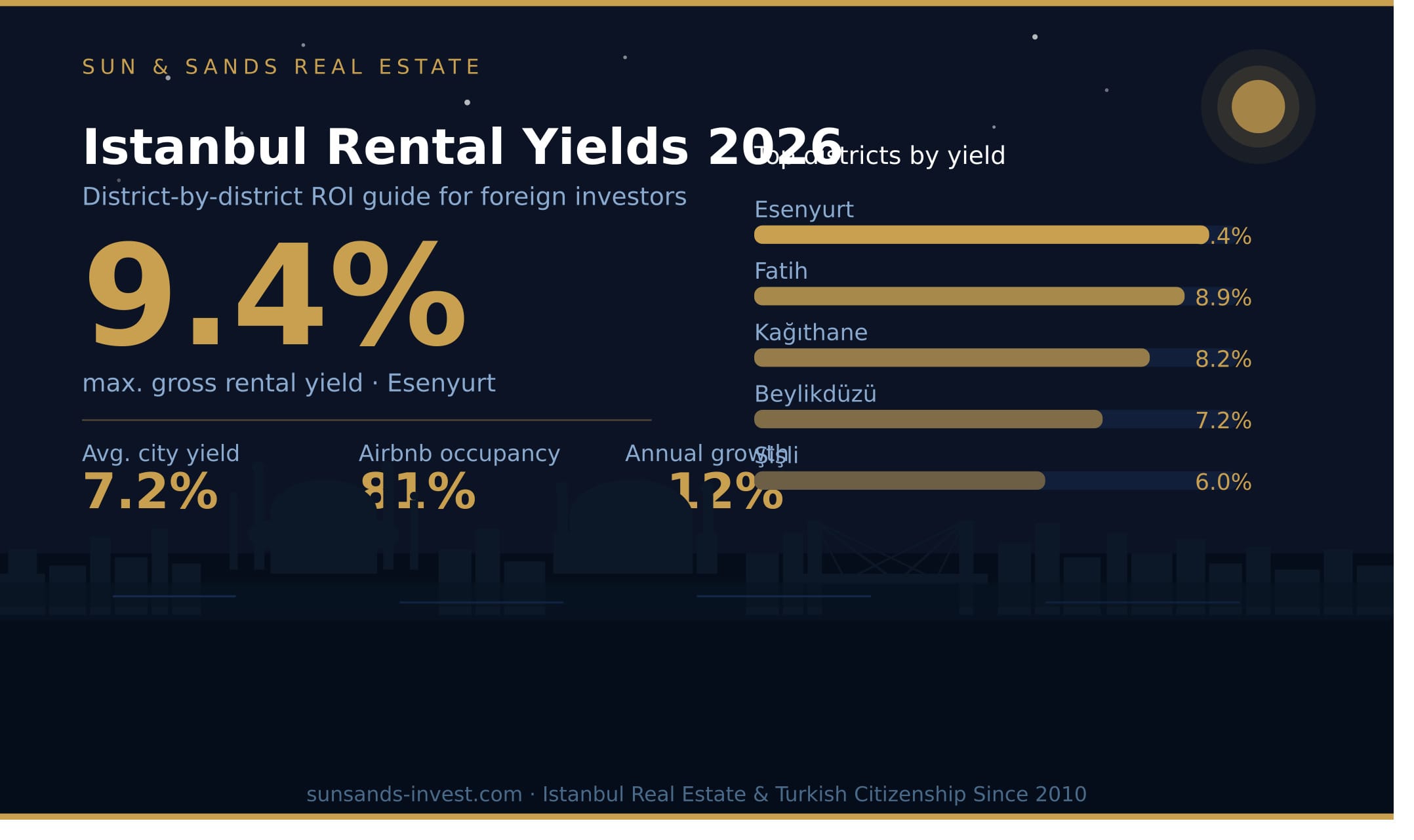
Istanbul rental yields in 2026 range from 7–9.4% per year, while also benefiting from capital appreciation, a clear legal framework, and an optional pathway to Turkish citizenship. In 2026, with global interest rates still elevated and many Western property markets stagnating, Istanbul is attracting serious capital from investors across the Middle East, Central Asia, and beyond.
But not all districts are equal. Choosing the right neighbourhood can be the difference between a 5% and a 9% annual return. In this guide, the Sun & Sands team breaks down the latest rental yield data by district, explains the Airbnb regulatory landscape, and shows you exactly where smart money is going in Istanbul right now.
Why Istanbul Rental Yields Lead Global Markets in 2026
Istanbul’s appeal as an investment market rests on three fundamentals that few other cities can match simultaneously: income yield, capital growth, and demand resilience.
Strong rental demand is driven by Istanbul’s population of over 16 million, a chronic housing undersupply in central districts, and a booming tourism sector that feeds the short-term rental market. Foreign visitors to Turkey exceeded 57 million in 2024, and Istanbul remains the country’s primary entry point — keeping Airbnb occupancy rates in tourist districts consistently above 65%.
Capital appreciation has been remarkable. Istanbul property values have risen at an average of 10–12% per year in dollar terms over the past three years, as the Turkish real estate market re-priced relative to hard-currency benchmarks. For investors holding assets in USD or EUR, Turkish property offers a compelling store of value at a time when local purchasing power has increased significantly.
Foreign buyer demand is accelerating: in 2025, foreign buyers accounted for 25% of all property purchases in Istanbul, with Gulf buyers, Iranians, and Russians leading the inflows. This demand supports both rental prices (landlords can price in USD or EUR for foreign tenants) and exit liquidity when it comes time to sell.
Istanbul Rental Yields by District — 2026 Data
The following yield ranges are based on current market data (gross yields, before tax and management costs):
High-Yield Districts (8–9.5%)
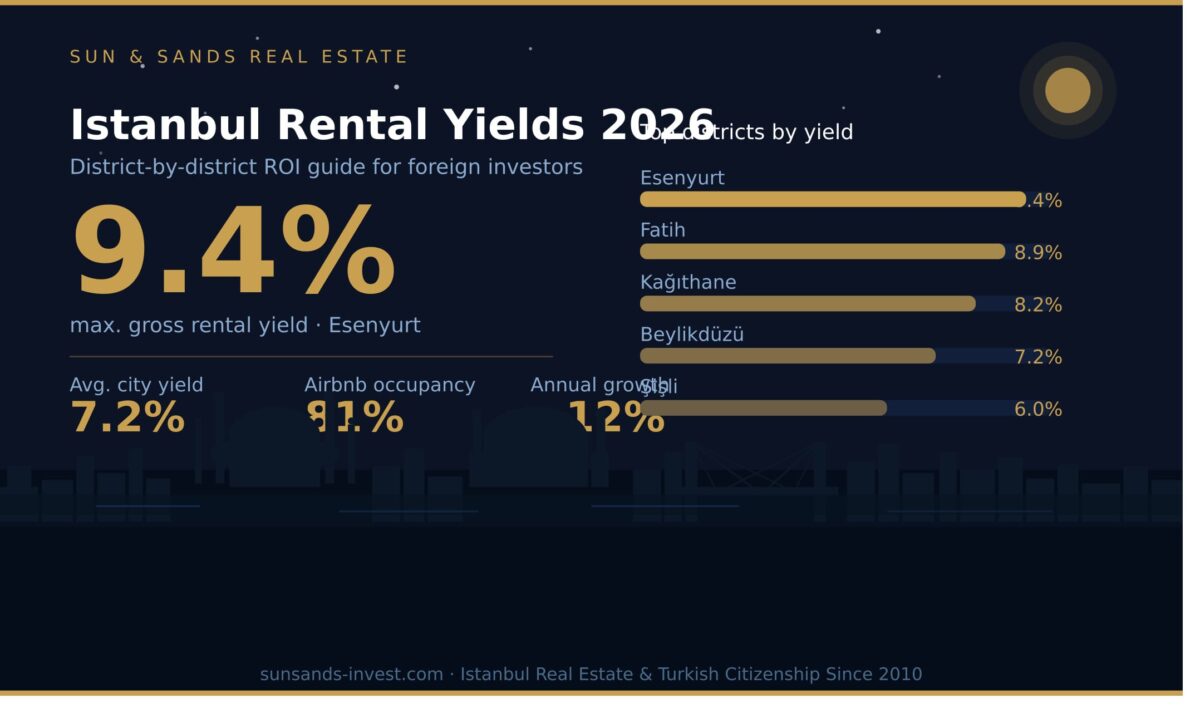
Esenyurt leads the city with gross yields of approximately 9.4%. This western district is Istanbul’s most affordable large-scale residential market, with strong demand from working-class and lower-middle-income tenants. Entry prices are the lowest in the city — quality apartments can be acquired from $60,000–$90,000 — making it accessible for investors at any budget. The trade-off is slower capital appreciation compared to central districts.
Fatih delivers yields around 8.9%, combining high tourist footfall (Sultanahmet, the Grand Bazaar) with strong long-term rental demand from university students and small business owners. Properties here are older stock but extremely well-located. Short-term rental potential is strong for investors willing to navigate the permitting process.
Güngören and Bağcılar (approximately 8.5%) are inner-western districts with dense residential populations. These are purely long-term rental plays — less glamorous, but highly liquid and extremely consistent.
Kartal offers gross yields of 8–10% on Istanbul’s Asian side, driven by sea-view apartments, fast-growing infrastructure, and steady demand from both long-term tenants and buyers eyeing future appreciation. Net yields after costs typically run 6–7%, with a payback period of roughly 12 years.
Mid-Yield Districts (6–8%)
Kağıthane is the standout growth story of 2026, with yields between 7–9% and some of the strongest appreciation logic in the city. It sits directly north of the historic core, is served by the M7 metro line, and has been the target of major urban regeneration investment. It offers both income and growth — a combination that’s hard to find in one district.
Beylikdüzü on the European coast delivers yields of 6.5–7.5%. This is a family-oriented, master-planned district with strong infrastructure, popular with Iranian and Arab diaspora communities. Sun & Sands has extensive experience here and it remains one of our top recommendations for investors seeking quality at a fair price.
Bahçelievler and Güngören sit at around 8.5% — well above the Istanbul average — and benefit from proximity to the E-5 transport corridor and dense tenant demand.
Pendik delivers gross yields of 7–9%, benefiting from Sabiha Gökçen Airport proximity, an expanding metro connection, and steady rental demand from airport-linked and logistics-sector tenants. Net yields run roughly 5–7%, with a payback period of about 13 years.
Başakşehir offers gross yields of 7–8%, anchored by large-scale planned developments, airport proximity, and a growing base of families and young professionals. Net yields run roughly 5–6%, with a payback period of about 14 years.
Premium Districts — Lower Yield, Higher Appreciation (4–6%)
Beşiktaş, Şişli, and Kadıköy are Istanbul’s most desirable residential addresses. Yields run lower — typically 5–6% — because purchase prices reflect the scarcity premium of central, Bosphorus-adjacent locations. However, these districts offer the strongest capital appreciation, the highest-quality tenant profile, and the best short-term rental performance. Şişli, for example, achieves Airbnb occupancy rates of 81% — the highest in the city.
Beyoğlu (Galata, Karaköy, Taksim) sits at a similar yield profile but benefits from exceptional short-term rental demand. Boutique apartments in Galata can command €80–€150 per night during peak season, making the gross short-term rental yield considerably higher than the long-term equivalent.
Sarıyer sits at the lower end of the yield spectrum, with gross yields of 3–5%, reflecting its position as one of Istanbul’s most exclusive, Bosphorus-adjacent districts. Investors here typically prioritize long-term capital appreciation and lifestyle over rental income, with payback periods extending to roughly 25 years on rental income alone.
Airbnb Investment in Istanbul: What You Need to Know in 2026
Short-term rentals are legal in Istanbul and represent a significant income opportunity — but the regulatory framework has tightened since 2023. Here is what every investor needs to understand before buying with Airbnb in mind.
Turkey’s Tourism-Purpose Rental Law (Law 7464) classifies any residential rental of 100 days or fewer as a “tourism-purpose rental.” To legally list on Airbnb or similar platforms, you must obtain a tourism-purpose rental permit from the Ministry of Culture and Tourism. Without this permit, listings risk fines and forced removal.
The permit application requires proof of property ownership (TAPU), a Turkish tax number, and compliance with building management rules (some apartment buildings prohibit short-term rentals via their internal regulations — always verify this before purchasing).
Top Airbnb districts by occupancy rate:
- Şişli: 81% average occupancy
- Beyoğlu: 71%
- Kadıköy: 68%
For a well-located, furnished 1+1 apartment in Beyoğlu purchased at $120,000, an investor achieving 70% occupancy at an average nightly rate of $80 can generate approximately $20,000 in gross annual revenue — a yield of around 16% before costs. Even after platform fees, management, and tax, net yields of 8–10% are achievable in prime short-term rental locations.
Long-Term vs. Short-Term Rental: Which Strategy Suits You?
The right strategy depends on your priorities and involvement level.
Long-term rental suits investors who want passive, low-management income. Returns are predictable — typically 6–9% gross — and Turkey’s rental market is robust with high demand in most Istanbul districts. Leases are typically signed in Turkish Lira but many landlords serving the expat and diaspora market price in USD or EUR, protecting against currency fluctuation.
Short-term rental (Airbnb) offers higher ceiling returns but requires active management or a reliable property management company. Sun & Sands can connect investors with vetted management partners who handle everything from permits to guest relations, for a typical fee of 20–25% of revenue.
Mixed strategy — using the property for short-term rental during peak tourist season (April–October) and long-term rental in the quieter months — is increasingly popular and can maximize annual income.
What Costs Reduce Your Net Rental Yield?
Gross yield figures above don’t tell the full story — actual take-home returns depend on ongoing costs. Property management typically runs 8–12% of rental income if you’re not managing the property yourself. Annual property tax in Turkey is modest, around 0.2% of assessed value. Budget roughly 1% of the property’s value per year for maintenance and upkeep. Together, these costs typically bring gross yields of 6–10% down to net yields in the 4–8% range — still competitive with most Western European markets, but worth planning for from day one.
Does Your Investment Qualify for Turkish Citizenship?
Properties valued at $400,000 or more qualify for Turkish citizenship by investment, provided you hold the property for a minimum of three years. Citizenship grants a Turkish passport — one of the most powerful in the region, offering visa-free access to over 110 countries and E-2 investor visa access to the USA.
For investors combining a citizenship purchase with a rental income strategy, districts like Beşiktaş, Şişli, and upscale Beylikdüzü developments offer properties in the $400K+ range with solid 5–6% long-term yields. The citizenship effectively comes at no additional cost — the property itself is the investment.
Why Work with Sun & Sands
Sun & Sands Real Estate has been operating in Istanbul since 2010. Our team has completed hundreds of title deed transfers for foreign buyers and managed the full investment cycle — from property selection and due diligence to rental management and citizenship applications — for clients from over 30 countries.
We don’t work on commission from developers, which means our recommendations are driven by what’s right for your investment goals, not by margins. If you’re evaluating Istanbul as an investment market, we’d be glad to walk you through current listings matched to your yield target and budget.
Contact us via WhatsApp or through sunsands-invest.com to book a free 30-minute investment consultation.
❓ FAQ BLOCK
Q: What is the average rental yield in Istanbul in 2026?
A: The citywide average gross rental yield in Istanbul is approximately 7.2% as of early 2026. Yields range from around 5% in premium Bosphorus-view districts to 9.4% in high-volume outer districts like Esenyurt.
Q: Which district in Istanbul has the highest rental yield in 2026?
A: Esenyurt currently leads with gross rental yields of approximately 9.4%, followed by Fatih at 8.9% and Güngören at 8.5%. These outer districts offer the highest income returns due to lower purchase prices and consistent tenant demand.
Q: Is Airbnb legal in Istanbul in 2026?
A: Yes. Short-term rentals are legal in Istanbul but regulated under Law 7464. Any residential rental of 100 days or fewer requires a tourism-purpose rental permit from Turkey’s Ministry of Culture and Tourism. Always verify that your building’s management rules also permit short-term letting.
Q: Can I earn rental income in USD or EUR from an Istanbul property?
A: Yes. Many landlords serving expatriate and diaspora tenants price rents in USD or EUR, providing a natural hedge against Turkish Lira depreciation. Short-term rental platforms like Airbnb also pay out in the currency of your choice.
Q: How much do I need to invest in Istanbul property to qualify for Turkish citizenship?
A: A minimum investment of $400,000 in one or more properties qualifies for the Turkish citizenship by investment programme. The property must be held for at least three years, after which it can be sold.